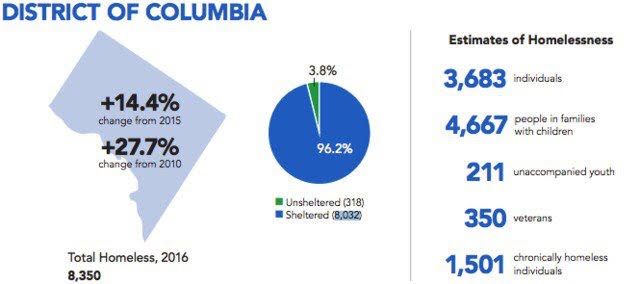
Its nice to know that the majority of the homeless have some type of shelter, but its sad how large this number is. It's also sad to see how many unaccompanied youth and veterans are homeless. It also makes me angry that more people aren't doing anything to help change this.
Together, we can end hunger.
Wednesday, November 30, 2016
Washington DC
As someone who has taken multiple service trips to help feed the homeless in Washington DC, I find these statistics very interesting.
Monday, November 21, 2016
Food Stamps in America
15% of the population is on food stamps. The majority of these people are not homeless or living in shelters. But people who can afford to pay for their living accommodations and other bills like heat and electricity, but that takes up all of their income so they can not afford food. Eligibility for food stamps depends on an individuals or a family's gross income. "To be eligible, a household has to earn a gross income amount that’s less than 130% of the poverty level, or a net income amount (gross income minus deductions) that’s less than 100% of the poverty level for their family size." This means that a person who's gross income is less than $1265 or a family who's gross income is less than $2584 per month are both eligible for food stamps.
Food Stamps in America are beneficial to many people , but they often have a bad reputation. Taxpayers often accuse people who use food stamps of being lazy and living off of the government. Well this may be true in some cases, so many people use food stamps because it is their only option. The amount of people on and cost of food stamps differs in individual states, and this difference can be observed in the chart above.
Friday, November 18, 2016
My Schools Food Drive
As parliamentarian of my schools National Honor Society I work with the other E-Board members to coordinate the years NHS run events. The past two weeks, we have been running a food drive. All the food collected goes to families in the school district, so its nice to know we are helping the community. Even though my school is in a nice area with mostly middle-class families, there are still people who struggle. To protect the confidentiality of students, only administration knows where the food is going.
Once we have collected all the food, we will sort the food into groups such as vegetables, fruit, soup, etc.. then make boxes with equal amounts of food from each category, for each of the families. A food drive of this size requires a lot of help from the entire NHS, but everyone is willing to help.
I encourage you to start a food drive in your school or community. You'd be surprised how many people around you actually struggle to get food everyday. It's a great feeling knowing I'm helping families in my community.
Once we have collected all the food, we will sort the food into groups such as vegetables, fruit, soup, etc.. then make boxes with equal amounts of food from each category, for each of the families. A food drive of this size requires a lot of help from the entire NHS, but everyone is willing to help.
I encourage you to start a food drive in your school or community. You'd be surprised how many people around you actually struggle to get food everyday. It's a great feeling knowing I'm helping families in my community.
Wednesday, November 2, 2016
Tuesday, October 18, 2016
Is Hunger Really Connected to Homelessness?
A common misconception is that the majority of food insecure people are also homeless. This, is false. Yes, the majority of homeless people are also suffer from food-insecurity, but not vice versa. A lot of times, a family can afford to pay rent, but that takes up all of their income so they cant afford food. Or for some reason someone might not have access to food or a way to access food. There is many different situations and reasons that this happens. One of the easiest ways to understand this is through the diagram at https://moveforhunger.org/hunger-and-homelessness/. The diagram has the number of homeless people, and the number of food insecure people living in all 50 states. The results are shocking, seeing that the number of hungry people is much higher than the number of homeless people.
This misconception also leads to stereotypes that people who go to food banks or get food stamps are lazy, and don't really need the help. I ask you to help end this stereotype, and understand that everyone has their own story, and you cant judge them because you are not in their shoes.
Thursday, October 6, 2016
Could Climate Change Impact World Hunger?
A recent article was published by the Washington Post titled "Wheat, one of the world’s most important crops, is being threatened by climate change". Wheat is one of the most significant crops in feeding the world, and if it becomes threatened, a large number of people could be impacted. The article explains how a recent study done by Nature Climate Change, shows that all the researchers agree that rising temperatures is going to be really bad for wheat production. The scientific facts can be read in the actual article at https://www.washingtonpost.com/news/energy-environment/wp/2016/09/12/climate-change-is-really-bad-for-wheat-which-is-really-bad-for-us/?utm_term=.4cd3aa2f9d0b, but for the purposes of this blog I'm going to focus more on the effects this problem could bring.
The prediction for the 2016/2017 year is 741 million tons of wheat produced, 500 million of which will be directly consumed by humans. Some statics from the study showed "China will see yield reductions of about 3.0 percent per 1 degree Celsius increase in global temperature. And India was projected to experience much greater declines of about 8.0 percent.". The statistics are different for every area of the world, but they all show one common thing; the amount of wheat production will decreases as the global temperature increases. This decrease in production will cause countries to find new ways to produce food to feed their citizens, some of which might be more expensive or need more land or equipment to produce. This will cause many new problems in ending world hunger, and create major setbacks. Personally, I already think global warming is an alarming issue that needs to be addressed, but this article has just furthered my concern.
I encourage you to read the article and respond with your thoughts in the comments :)
The prediction for the 2016/2017 year is 741 million tons of wheat produced, 500 million of which will be directly consumed by humans. Some statics from the study showed "China will see yield reductions of about 3.0 percent per 1 degree Celsius increase in global temperature. And India was projected to experience much greater declines of about 8.0 percent.". The statistics are different for every area of the world, but they all show one common thing; the amount of wheat production will decreases as the global temperature increases. This decrease in production will cause countries to find new ways to produce food to feed their citizens, some of which might be more expensive or need more land or equipment to produce. This will cause many new problems in ending world hunger, and create major setbacks. Personally, I already think global warming is an alarming issue that needs to be addressed, but this article has just furthered my concern.
I encourage you to read the article and respond with your thoughts in the comments :)
Subscribe to:
Posts (Atom)